

Your homepage headline should say what you do, for whom, and why it's worth a stranger's next ten seconds. In plain words. In one line.
That sounds obvious, but it’s the line most small businesses get wrong. Everything you could say about your business is competing for a very small space.
Here's the test I use on every homepage I read: could a competitor put their logo above your headline and use it as is? If yes, it isn't doing its job yet.
What job does the headline have?
Whether it’s a website or social profile, a visitor decides in a few seconds whether to keep reading. In that time, your headline has three jobs:
Say what you do. In the words a customer would use, not your industry's.
Say who it's for. Even a hint narrows it enough to matter.
Give one reason to care. The outcome, the difference, the thing people thank you for.
It doesn’t have to do everything. The subhead and photo carry some of the weight. But the headline has to make the right person think, “This is for me.”
Why most headlines miss
Most weak headlines I see fall into one of three traps.
Vague. "Quality solutions for your business." Every business could say it, so it says nothing.
Clever. A pun or inside joke that makes sense once you already know what the company does. Strangers don't, yet.
About you. "Welcome to our website" or "Family-owned since 2009." True, maybe lovely, but it answers a question nobody asked first.
Why does this happen?
My assessment:
Headlines are usually written by someone who knows the business too well, or not at all. Insiders reach for the language they use with colleagues. Outsiders, including AI, fill the gap with safe, general words. The best headlines come from the middle: someone who knows the business, talking to someone who doesn’t.
A simple way to write your own headline: borrow from your sales calls
You already have a good headline. You say it out loud every time someone asks what you do and you've got about ten seconds to answer. The trick is to write that down instead of starting from a blank page.
Recall a real conversation. The last time someone asked what you do, what did you actually say?
Write it down word for word. Don't polish it yet.
Circle the part that made them lean in. Usually it's a specific outcome or a detail no one else mentions.
Cut everything else. Aim for under 12 words.
Run the competitor test. If someone else could sign it, add the detail only you would say.
EXAMPLE: Juniper & Ledger Bookkeeping
Here's what that looks like for a fictional bookkeeper, Juniper & Ledger:
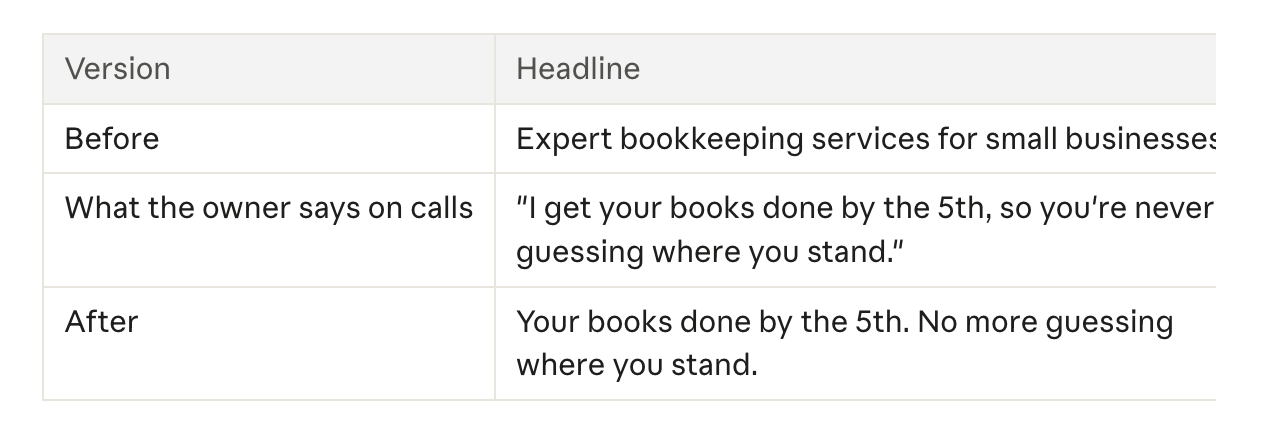
Our Example Headline Goes from Cliche to Clarity
Changing this one line can help create a whole new framework for the rest of the copy on the page, and set our bookkeeper apart from the rest.
The result is that the "before" is accurate and forgettable. The "after" is something only this bookkeeper would promise, and it's what their clients actually care about.
Check it before you publish
Would a stranger know what you sell after reading only this line?
Is it in your customer's words, not your industry's?
Could a competitor sign it? If yes, add your detail.
Is it under about 12 words?
Did you keep your search keywords? They belong in the page title and subhead, so the headline can sound like a person.
A smaller way to fix a specific problem
A lot of businesses with a fixable homepage problem don't need a full website project, or can't justify one right now. So I've started turning pieces of this work into short exercises I call marketing microdoses, and they live in my shop, Alan Aldous.
Collection 001: Say What You Sell focuses on homepage messaging. One exercise, Sales Call to Homepage, picks up where this post leaves off. You start with how you explain your business aloud and finish with a draft headline and supporting sentence.
It includes:
A fictional worked example
A fillable worksheet
A way to check your answer
It won't replace a full website project. It's built to help you finish one specific job.
If you want to work through your whole homepage, Collection 001 also includes The Homepage Test, The Proof Check and The Feedback Fix. Prices run from C$9 for a single exercise to C$29 for the full collection.